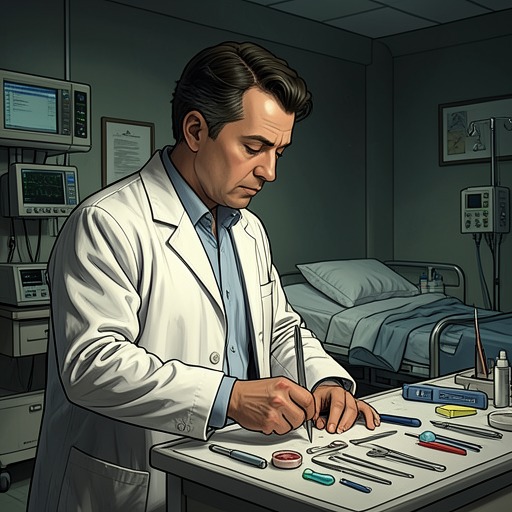
John Christow–Mrs Crabtree doctor-patient relationship
The HollowThe John Christow–Mrs Crabtree doctor-patient relationship is the emotional and professional centre of John Christow’s life as a physician. Mrs. Crabtree is not merely one patient among many: her Ridgeway's Disease makes her John’s rare and apparently incurable case, while her indomitable will to live gives his research a human urgency. Their alliance joins scientific ambition to mutual vitality, but it also reveals the risks of a doctor whose commitment to discovery can turn a patient into a proving ground. After John’s death, the relationship survives as a responsibility passed to those who remain.
Identity and Foundation
John meets Mrs. Crabtree within the institutional world of St. Christopher's Hospital, amid long rows of beds and patients whose suffering often reduces medical work to palliation. He finds much of his private practice financially profitable but spiritually barren: sickly women and repetitive ailments offer little that he can investigate or overcome. Mrs. Crabtree is different. She has Ridgeway's Disease, a rare condition described as inevitably fatal because no cure exists, and John is attempting to devise one through difficult work involving hormone secretion, toxicity, and pantratin.
The contrast between the two settings defines the relationship from the beginning. In his consulting room, John can produce sympathy almost automatically. He listens, asks questions, gives directions, and sends a patient away feeling stronger, yet forgets her as soon as the door closes. With Mrs. Crabtree, by contrast, his attention is not a professional performance that ends with the consultation. Her case engages his intellect, his uncertainty, and his competitive determination. She is the patient who gives him something substantial to get his teeth into.
Mutual Vitality and Medical Work
John sees Mrs. Crabtree as a fighter. Her life is harsh: she lives in a slum, has a husband who drinks, cares for unruly children, and works through the day scrubbing office floors. Yet she wants to live and enjoys existence for its own sake. John recognizes the same zest in himself and understands their bond as a shared allegiance to life rather than to comfortable circumstances. The relationship therefore exceeds the usual division between active doctor and passive sufferer. Mrs. Crabtree’s will becomes part of the treatment itself, while John’s confidence and energy help her endure its demands.
The treatment is experimental and precarious. John is pleased when Mrs. Crabtree can stand for a short period, but an alarming rise in toxicity follows, and a D.L. reaction proves negative when he had expected it to be positive. He leaves her bedside miserable and uncertain, forced to confront the possibility that his theory has failed. His subsequent thinking is concrete and technical: he must reduce the toxicity, preserve the hormone content, and neutralize the pantratin. His earlier confidence has become self-reproach; he realizes that he had been too sure he had circumvented every difficulty.
Even in crisis, physical contact carries the relation’s distinctive force. When John places his hand on Mrs. Crabtree’s pulse, the narrative describes vitality passing from him to the panting old woman. The image makes medicine reciprocal: he measures her body, but her determination also replenishes the purpose that his exhausting clinical work has drained. Mrs. Crabtree jokes that he is making a guinea pig of her, and John answers that the aim is to make her well. Her consent is expressed through rough humour and stubborn participation rather than through solemn medical language. She tells him to continue, insists that she can stand it, and frames survival as a family inheritance, recalling that her mother lived to eighty-eight and her grandmother to ninety.
Scientific Alliance and Ethical Tension
John’s attachment to Mrs. Crabtree is genuine, but it is not uncomplicated. He values her because she is both a person with an exceptional will and the central subject through whom his medical theory might become a cure. The language of the guinea pig exposes the danger within his enthusiasm: the patient is a collaborator, yet also an experimental body. Her willingness to endure pain does not erase the unequal power of the clinical setting or the risks of a treatment whose results remain uncertain.
The relationship nevertheless gives John an ethical seriousness absent from his resentful domestic reflections and from the polished service he provides to wealthy Harley Street patients. Henrietta Savernake later tells Hercule Poirot that John’s real interest, excitement, and sense of adventure lay in his work, not in the women associated with his personal life. She identifies Mrs. Crabtree as the person who would have been uppermost in his mind if he had been asked which woman mattered most to him. Her description insists that the case, the patient, and the scientific problem were inseparable in John’s imagination: Ridgeway's Disease and Mrs. Crabtree occupied his thoughts night and day.
That account also corrects the misleading public story that threatens to follow John’s murder. Henrietta fears that headlines will reduce him to a doctor surrounded by a complicated love life involving Gerda Christow, Henrietta herself, and Veronica Cray. Against that interpretation, she presents Mrs. Crabtree as evidence of another John: a physician whose deepest excitement came from intense scientific curiosity and achievement. The doctor-patient relationship thus becomes part of the novel’s struggle over who John was allowed to be after his death.
What Remains After John’s Death
Mrs. Crabtree survives John, but the treatment is now administered by a younger doctor with spectacles whom she finds markedly different. He never laughs, and she contrasts his manner with John’s jokes and encouragement. John had told her that she and he were going to make medical history; when she complained that she could endure no more, he answered that she was tough and could take it. His humour did not make the treatment less serious. It transformed endurance into a shared undertaking and made Mrs. Crabtree feel that she could not let him down.
After John’s death, the emotional balance reverses. Henrietta visits Mrs. Crabtree and urges her not to surrender. The treatment remains the same, but Mrs. Crabtree must now have the courage for two and make medical history by herself, for John. Mrs. Crabtree regards the prospect with wary humour, calling it grand and promising to do her best. Her response preserves the rough, practical tone that characterized her exchanges with John, while also marking the cost of his absence: the alliance that once drew strength from two active participants must now be carried forward by the patient alone.
Narrative and Thematic Significance
The relationship distinguishes John’s authentic vocation from the emotional exhaustion that increasingly governs his private life. His marriage to Gerda Christow is strained by his irritability, and his professional routine leaves him tired and dissatisfied, yet Mrs. Crabtree restores his sense of purpose whenever the work becomes genuinely difficult. After a setback, he thinks of Henrietta Savernake’s beauty and vitality, but the evidence of his deepest professional commitment lies elsewhere, in the old woman who is willing to suffer in order to live.
Mrs. Crabtree therefore functions as both patient and moral test. She embodies a desire for life that is not dependent on social privilege, health, or ease, and she forces John to meet suffering as something more demanding than a case history. At the same time, her treatment keeps the darker side of his vocation visible: his brilliance is inseparable from risk, self-confidence, and the temptation to measure a human life through the success of an experiment. The bond’s final image is not a cure or a triumphant medical conclusion, but Mrs. Crabtree’s promise to continue. John’s work survives only as a fragile alliance between memory, discipline, and the patient’s own refusal to let life go.